Making equal packs? Finding when two lights flash together again? First say what you need to find. Then choose the calculation.
In this lesson, you’ll see both ideas, follow two complete solutions, and try a new question.
Original TutorMax explanationFocused topic · partial chapter coverage
1. HCF: make the greatest number of identical packs
A club has 12 red beads and 18 blue beads. It wants to use every bead to make as many identical packs as possible.
Every pack must have the same number of red beads and the same number of blue beads. The beads stay whole, and none can be left over.
What are we finding? The number of packs.
Step 1: Find which pack counts work
Could we make 3 packs?
12 ÷ 3 = 4 red beads in each pack
18 ÷ 3 = 6 blue beads in each pack
Yes. Both divisions give whole numbers, so 3 packs work.
Could we make 4 packs?
12 ÷ 4 = 3 red beads in each pack
Giving each pack 4 blue beads uses 4 × 4 = 16 blue beads, leaving 2. We cannot share those 2 equally between the 4 packs as whole beads.
So 4 packs do not work.
A number that divides a total exactly is called a factor of that total. We need a pack count that is a factor of both 12 and 18.
Step 2: Find the greatest pack count that works for both
Here are all the factor pairs. Each pair multiplies to give the total:
12: 1 × 12, 2 × 6, 3 × 4
18: 1 × 18, 2 × 9, 3 × 6
So the possible pack counts are:
For 12 beads: 1, 2, 3, 4, 6, 12
For 18 beads: 1, 2, 3, 6, 9, 18
The counts in both lists are 1, 2, 3 and 6. The greatest is 6.
That is the highest common factor, or HCF. “Common” means shared by both lists.
HCF of 12 and 18 = 6. We can make at most 6 identical packs.
Step 3: Find what goes in each pack
12 ÷ 6 = 2 red beads per pack
18 ÷ 6 = 3 blue beads per pack
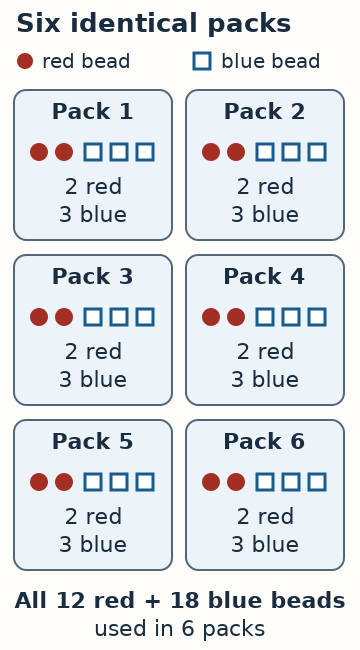
Six identical packs. Each pack has 2 red beads and 3 blue beads.
Packs 1–6 use all 12 red beads and 18 blue beads, with none left over.
Answer: 6 packs, with 2 red beads and 3 blue beads in each pack.
Check the answer
6 × 2 = 12 red beads, and 6 × 3 = 18 blue beads. We used every bead. The factor lists show that no larger pack count works for both totals.
Read the picture: 6 counts the packs. Each pack contains 5 beads: 2 red + 3 blue.
2. LCM: find when two repeats meet again
Light A flashes every 12 seconds. Light B flashes every 18 seconds. They flash together now.
How many seconds will pass before they next flash together?
We are finding an elapsed time. That time must contain a whole number of 12-second waits and a whole number of 18-second waits.
Step 1: List the times after the shared start
For Light A, keep adding 12:
12 seconds
12 + 12 = 24 seconds
24 + 12 = 36 seconds
For Light B, keep adding 18:
18 seconds
18 + 18 = 36 seconds
These are multiples: 12, 24 and 36 are 1, 2 and 3 lots of 12. Similarly, 18 and 36 are 1 and 2 lots of 18.
Step 2: Find the first time in both lists
Both lights flash at 0. Their first shared flash after that is at 36 seconds.
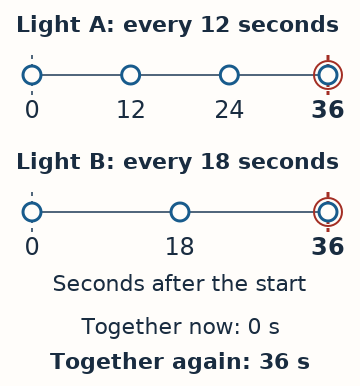
On the same time scale, Light A flashes at 0, 12, 24 and 36 seconds; Light B flashes at 0, 18 and 36 seconds.
The first shared time after the start is 36 seconds. There is no earlier positive time in both lists.
That is the least common multiple, or LCM: the smallest positive number in both lists of multiples.
LCM of 12 and 18 = 36.
Answer: The lights next flash together after 36 seconds.
Check the answer
36 ÷ 12 = 3 complete waits for Light A
36 ÷ 18 = 2 complete waits for Light B
Both lights reach a flash at 36 seconds. At 0 seconds they are already flashing together; the question asks when it happens again.
3. Same numbers. What changed?
In both examples, the numbers were 12 and 18. The question decided the method.
Packs: split both totals exactly.
The pack count must divide both totals. We want the greatest possible count, so we find the HCF: 6 packs.
Lights: build up both repeating times.
The elapsed time must be a multiple of both intervals. We want the first shared time after the start, so we find the LCM: 36 seconds.
Before calculating, finish this sentence:
“I am finding ______. It must divide both numbers / be a multiple of both numbers.”
Be careful: “greatest” does not always mean HCF
For the same lights, suppose the question asks: What is the greatest time below 80 seconds when they flash together?
They meet every 36 seconds: 36, 72, 108, …
72 is below 80, but 108 is above it.
Answer: 72 seconds after the start. We still used their shared repeat time, the LCM, to find the coincidences. A single word cannot choose the method for us.
4. Try a new situation
Two ribbons are 16 cm and 24 cm long. Cut them into pieces of the same length, using both ribbons completely.
What is the greatest possible length of each piece? How many pieces will there be altogether?
Before you work it out:
Are you finding a piece length or a repeating time?
Must that length divide both ribbon lengths, or be a multiple of them?
Show the solution+
Solution
We need a piece length that fits exactly into both ribbons. To make each piece as long as possible, find the HCF.
Factors of 16: 1, 2, 4, 8, 16
Factors of 24: 1, 2, 3, 4, 6, 8, 12, 24
Common factors: 1, 2, 4, 8
Greatest common factor: 8
Each piece is 8 cm long.
16 ÷ 8 = 2 pieces from the first ribbon
24 ÷ 8 = 3 pieces from the second ribbon
2 + 3 = 5 pieces altogether
Check: 2 × 8 cm = 16 cm and 3 × 8 cm = 24 cm. Both ribbons are used completely.
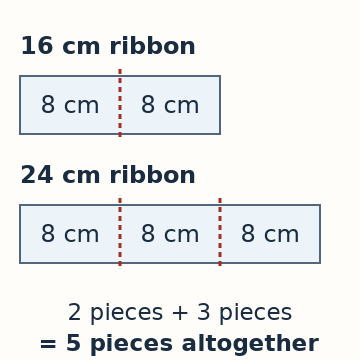
The same 8 cm piece fits twice into 16 cm and three times into 24 cm.
There are two pieces from the first ribbon and three from the second: five pieces altogether.
Answer: Each piece is 8 cm long, and there are 5 pieces altogether.
Notice what 8 means here: centimetres per piece. In the bead example, the HCF gave a number of packs. Always name the quantity you found.
5. Ready for larger numbers?
See how prime factors help with 48 and 72+
Listing factors or multiples is useful for seeing the idea. For larger numbers, we can use prime factors.
A prime number is a whole number greater than 1 that has only two factors: 1 and itself. For example, 2 and 3 are prime. Prime factorisation means writing a number as a multiplication of prime numbers.
Break each number into prime factors
Keep splitting until every factor is prime:
48 = 2 × 24
= 2 × 2 × 12
= 2 × 2 × 2 × 6
= 2 × 2 × 2 × 2 × 3
72 = 2 × 36
= 2 × 2 × 18
= 2 × 2 × 2 × 9
= 2 × 2 × 2 × 3 × 3
HCF: use the prime factors both numbers can supply
We can match three 2s and one 3 between the rows. Their product divides both numbers:
HCF = 2 × 2 × 2 × 3 = 8 × 3 = 24.
The fourth 2 appears only in 48. The second 3 appears only in 72. Neither can be included in a factor shared by both.
Suppose we use all 48 pencils and all 72 erasers, with the same number of pencils and the same number of erasers in every pack. We can make at most 24 identical packs: 48 ÷ 24 = 2 pencils and 72 ÷ 24 = 3 erasers per pack.
LCM: include enough prime factors to contain either number
A multiple of 48 needs four 2s and one 3. A multiple of 72 needs three 2s and two 3s.
To cover both, use four 2s and two 3s. We use only as many copies as needed:
LCM = 2 × 2 × 2 × 2 × 3 × 3 = 16 × 9 = 144.
If two lights flash every 48 and 72 seconds and start together, their next shared flash is after 144 seconds.